
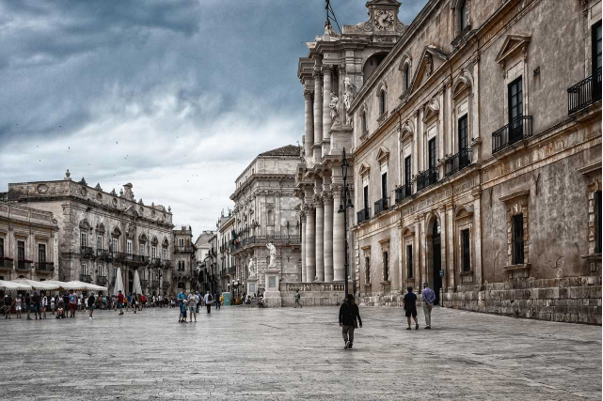
Syracuse doesn’t hide its famous angles, but it doesn’t rely on them either. The city isn’t short on viewpoints; it’s short on patience for spectacle. The most interesting perspectives tend to appear when nothing is framed, announced, or elevated to “must-see” status.
They’re not views you arrive at. They’re views you notice while doing something else.
The Sea, Briefly and Without Drama
In Syracuse, the sea often shows up indirectly. At the end of a street that wasn’t meant to lead anywhere. Reflected in a shop window. Visible for a few seconds before the buildings close in again.
These moments are incomplete by nature. No horizon line, no symmetry. Just enough water to remind you where you are. Because they’re fleeting, they register more clearly than the obvious panoramas.
Ortigia from Just Above Street Level
You don’t need height to see Ortigia differently. A single flight of stairs is enough. From there, rooftops overlap in no particular order. Antennas interrupt the skyline. Terraces look improvised rather than designed.
The sea is still present, but it’s secondary. What you notice instead is how people live with limited space, adjusting, adding, repairing. It’s not picturesque. It’s informative.
The Western Edge at the End of the Day
The western side of Ortigia doesn’t offer a signature view. That’s part of its appeal. As the day ends, light shifts gradually, without a clear moment worth photographing.
People linger without purpose. Someone leans on a wall. Someone else keeps walking. The stone changes tone almost imperceptibly. Nothing is highlighted, which makes everything easier to observe.
Seeing More by Staying Put
Syracuse reveals itself through repetition rather than novelty. Passing the same corner at different hours produces more insight than finding a new viewpoint every day.
This is where location truly matters. Even the choice to stay in hotels in Syracuse and its historic area isn’t about being close to attractions; it’s about continuity. You see streets wake up, empty out, reset. Views become familiar, then meaningful.
Looking Up Near the Markets
Around the markets, attention is usually directed downward — toward stalls, hands, transactions. If you look up instead, a different Syracuse appears.
Balconies stacked unevenly. Shutters at various stages of repair. Plants growing where they weren’t planned to. These vertical views are uncomposed and practical. They show how the city adapts rather than how it presents itself.
The Harbor Without Activity
The harbor is least interesting when something is supposed to be happening. Boats moving, people watching, cameras raised.
At quieter hours, when nothing aligns into a scene, the harbor becomes readable. Water reflects light unevenly. Movement slows to drifting. The absence of action sharpens perception.
Ortigia Seen from Inland Streets
From certain inland streets, Ortigia looks smaller than expected. Less iconic. More provisional.
Seen at a distance, the historic center stops dominating the city’s identity. It becomes one element among others — connected, not elevated. This perspective makes Syracuse feel less like a destination and more like a place that functions.
Why These Views Stay With You
These aren’t views designed to impress or summarize. They don’t explain Syracuse. They don’t perform.
They reward attention rather than anticipation. And because you weren’t told to look for them, you tend to remember them more accurately — not as images, but as moments when the city briefly aligned with your pace.
That alignment, quiet and unremarkable, is what lingers.