Why AI discovery fails without measurable presence
Modern buyers rarely search only with classic keywords. They ask questions in assistants and AI summary experiences, then rely on the answers those systems generate. If your brand is not consistently mentioned and cited AI Visibility Platform there, you can lose demand even while your website traffic looks stable. The problem is that “being online” is not the same as being surfaced inside AI answers.
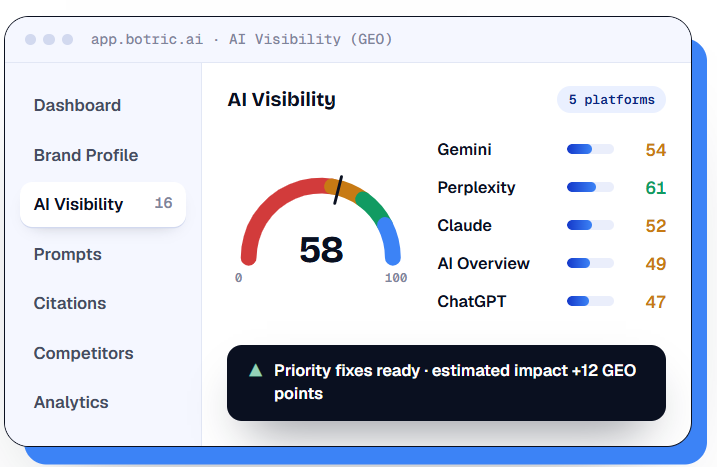
Many teams assume that publishing content automatically creates AI visibility, but language models do not index the web in a simple, deterministic way. Mentions may be inconsistent, attributions may be missing, or your name may be replaced by generic alternatives. Even when you do show up, you may not understand which channels—ChatGPT, Google AI Overviews, Gemini, Perplexity, or Claude—are actually referencing you. Without measurement, it’s difficult to tell whether gaps come from content quality, authority signals, or retrieval and citation behavior.
The real goal: move from guesswork to attribution
An effective approach starts by defining visibility as something you can observe and improve. An AI visibility tracker focuses on how often your brand appears in AI responses and whether those responses cite your sources. That matters because citations influence trust and downstream user behavior. When the assistant points to you as a reference, users are more likely to visit, subscribe, or request demos.
The next step is mapping that visibility to specific audiences and queries. Many brands have multiple products, locations, and use cases, yet they evaluate performance at only the domain level. A visibility platform helps you understand which narratives are being picked up by AI systems and where your mentions cluster. You can then align your content and digital strategy with the questions your market is actually asking.
In practice, this means building a feedback loop between what you publish and what AI systems repeat. When you see a mention drop in certain models, you can investigate whether key pages are missing, outdated, or not structured clearly enough to be retrieved. When citations increase after improvements, you can identify which changes drive better referencing. Over time, the goal shifts from hoping to being discovered in a measurable, repeatable way.
How an AI Visibility Platform pinpoints the gaps
A strong AI visibility tracker works like a monitoring layer for AI references, not just web analytics. It checks where your brand name and related entities appear across major AI ecosystems, then records frequency and citation behavior. This gives you visibility into both brand recall and source credibility. Instead of relying on one-off observations, you gain ongoing insight into what AI systems are learning and sharing.
For example, your team might notice that ChatGPT frequently mentions your company but rarely cites your official documentation. That pattern suggests a content gap in authoritative pages or a mismatch between the way your site is structured and how AI systems retrieve it. Alternatively, you may see citations but low mention volume in Gemini or Perplexity, indicating that your content is not being associated with the right problem statements. A visibility platform helps you separate these scenarios so your next action targets the true cause.
These insights become even more valuable when you compare your brand against competitors. If your rivals appear more often and are cited more reliably, you can audit what they cover, how they package knowledge, and where they earn authority signals. You can also prioritize which segments to address first based on the magnitude of the visibility gap. The result is a roadmap that connects AI discovery to concrete improvements rather than random content production.
Problem-solution workflows that turn visibility into growth
Once you can measure mentions and citations, you can design specific workflows for improvement. Start with a baseline: track current visibility across major AI systems for your core brand queries and product-related questions. Then identify where you are under-cited or under-mentioned, and categorize the causes into content relevance, source authority, or entity clarity. This creates a problem list your marketing, content, and SEO teams can actually execute against.
Next, implement targeted fixes rather than broad updates. If AI answers reference you without citations, strengthen the most relevant pages by adding clear definitions, structured FAQs, and consistent brand and product naming. If mentions appear but drift away from your preferred narrative, refine content to directly address the decision criteria customers use. If citations are rare in specific assistants, improve discoverability by ensuring key knowledge is accessible, indexable, and aligned with how your audience asks questions.
It also helps to coordinate internal teams around a shared measurement standard. Instead of arguing whether “our brand is showing up,” teams can review the same visibility data and agree on what changed after each initiative. You can evaluate whether a new guide increases citations in AI overviews or whether a technical page improves mentions in model answers. This reduces friction and accelerates learning cycles by linking efforts to outcomes.
Finally, use visibility tracking to inform long-term strategy. When you see consistent citations growing, you can expand coverage into adjacent problem areas and build content clusters that reinforce authority. When visibility stagnates, you can revisit distribution, source quality, or the clarity of entity relationships on your site. Over time, your brand becomes a more reliable reference in AI responses, which supports both demand generation and reputation.
Conclusion
AI brand visibility is not just a marketing buzzword—it’s a measurable advantage that affects whether buyers encounter you inside AI-powered answers. Without tracking, teams often react to silence with more content, even when the real issue is attribution, entity clarity, or retrieval mismatch. A visibility-focused approach turns that uncertainty into a clear set of signals you can act on. By monitoring how often your brand is mentioned and cited across major AI systems, you can pinpoint gaps and prioritize the fixes that move the needle. That problem-solution workflow helps you strengthen authoritative sources, align content with real query intent, and improve the likelihood that assistants reference you accurately. With consistent measurement and targeted improvements, your AI discovery presence becomes a durable growth channel.